Showing posts with label Book Review. Show all posts

Sunday, November 13, 2016

Books by Thich Nhat Hanh

 After spending time with Pema Chodron, I was directed to read the writings of Thich Nhat Hanh, a Vietnamese Buddhist monk who lives in exile for refusing to take sides in the political strife that we call the Vietnam War. 

I chose these two to start - short and simple. His writings contain a depth that I had not found in the writings of others on the subject of mindfulness. Perhaps it's his experience with deep suffering and pain that makes his way different. Whatever the reason, I feel as if I truly just began my own practice of mindfulness as I read these two books.  

I found myself breathing more mindfully just reading the words, awareness rising with a consistency that I had not been able to maintain before.  Even in the middle of an energy-draining day at work, I've been able to stop and breathe.

How to Sit is a short, concise book about, well, how to sit! Here is how sitting is defined:

"To sit, in this book, means to sit in such a way that you enjoy sitting, to sit in a relaxed way, with your mind awake, calm, and clear."

Here are a few quotes I highlighted from The Miracle of Mindfulness:

"... consider the act of each step we take as an infinite wonder."

"Every day we are engaged in a miracle which we don't even recognize: a blue sky, white clouds, green leaves, the black, curious eyes of a child - our own two eyes. All is a miracle."

"Keep your attention focused on the work, be alert and ready to handle ably and intelligently any situation which may arise - this is mindfulness."

"... a calm heart and self control are necessary if one is to obtain good results."

"Breath is the bridge which connects life to consciousness, which unites  your body to your thoughts. Whenever your mind becomes  scattered, use your breath as the means to take hold of your mind again."

Practical and clearly written, I have never felt more grounded, more peaceful, or content with life as I have since putting into practice what I have learned from his writings. As anxiety, fear, tension arise, as they will no matter what, I can use his strategies to detach and not fall into self-reproach or codependency. 

Some of it surprised me as he presents the idea of seeing your own body as it decomposes and becomes white bones. This rather shocked me at first, but I see the point now. It's all part of the cycle of life and this physical body is only one manifestation of who we are. I am separate from my body - it's just a shell, a means to function on this earth. 

Buddhism is not incompatible with other religions - it adds a dimension that merely helps us to truly live life with a fullness that I found lacking in my past.

Anyway, I hope you'll give them a read. They both get a 5 star rating!


Wednesday, August 17, 2016

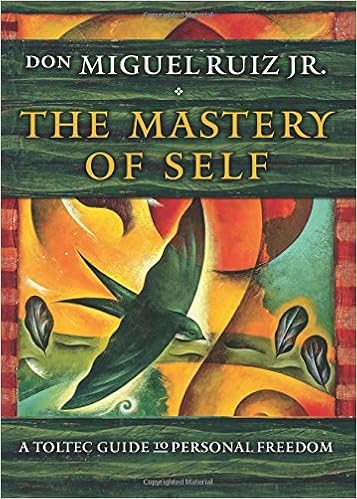
The Mastery of Self - A Book Review


“The mastery of self is the only mastery that matters.”  ~ Yoda

Browsing Powell’s City of Books, I followed Liz to the section comprised of books on meditation, philosophy, and religion.  Casually scanning the selections, I was drawn to the colorful jacket of this book recognizing it as a companion to The Four Agreements, a book Chuck had read and liked (written by the author's father). The title caught my eye as well, as I’ve been on this path for a very long time yet not feeling as if I was making much progress. I wasn’t seriously considering buying it as it was pretty expensive (in my view) even though a quick look showed me that it would be a worthwhile read.  So… my wise friend quietly spoke, “Remember what Yoda says…” I knew I was being drawn to that book but was resisting… again. So, I grabbed it and made the purchase, fighting my frugal habits.

The mastery of self.  What does that really mean?

Before I begin my summation, I want to lay out the four agreements as a background:

 Be impeccable with your word.
Don’t take anything personally.
Don’t make assumptions.
Always do your best.

I committed myself to work through the exercises with openness and honesty, the goal being to change destructive habits and thought patterns in my life.  I was attracted to what looked like a practical guide as I need help applying what I have been learning. This IS one such book. 

He lays the foundation creating a picture that describes the state of humanity (one giant party where everyone is intoxicated - except you, and no one realizes it - except you) and the individual person’s journey towards lasting personal change, the challenges each of us faces and some practical applications to help on the journey.  If, and that’s a big IF, one is willing to do the hard work of working through the exercises with honesty and diligence, this guide can, indeed, be a game changer.

How do I pull out the essence of such a guide? There is far too much for this small blog post, but I’ll make an attempt to list out the highlights of my take-aways.

The list of terms and definitions at the beginning was very helpful. Some examples:

a.     Personal dream: the unique reality created by every individual; their perspective, a manifestation of the relationship between mind and body, and intent is the energy that animates both.
b.    Dream of the Planet: the manifestation of our shared intentions, where we allow our ideas and agreements to flow between us.
c.     Domestication: the system of control in the Dream of the Planet; the way we learn conditional love.

Some key ideas:

~ You become a Master of Self when you remain your Authentic Self in interacting with others and maintain the awareness that every choice you make is your own.

~ Attachment is taking something that is not part of you and making it so through emotional investment. You lose the ability to detach when the moment ends or when the belief no longer reflects the truth.

~ The Smoky Mirror shaman story – there is a smoky fog clouding our vision and connection to our true selves. As the fog recedes, there is a mirror showing us our true selves.

“Self-domestication is the act of accepting ourselves on the condition that we live up to the ideals we have adopted from others.”

“Because we adopted an external belief, we either rejected or tried to change… so we could feel worthy of our own self-acceptance and the acceptance of others.”

“When you become attached to an object, idea, or belief, you make it part of who you think you are.”

~ He describes that voice in our heads as either the ‘parasite’ or the ‘ally’.

~ Make a commitment to unconditional self-love. Become willing to love every aspect of yourself without judgment or conditions.

“I am only responsible for the clarity and integrity of what I say – not what others hear and feel – because I don’t control others perceptions.”

“… beliefs don’t exist ‘out there’ in the world; they exist only in your mind and only as long as you continue to believe.”

“… true justice is paying for something once; injustice is paying for it over and over again.”

“If you see the world through the eyes of conditional love, you are… attempting to control others… so that they conform to the definition of who and what you think they should be.”

“… unconditional love… the engagement of equals, using knowledge and awareness to co-create a dream whose diversity reflects the free will of each individual living in this moment.”

~ Resentment: self-inflicted suffering with the emotional poison we wish for another.

"We do the best we can and release our attachment to the outcome."

~ On the need to forgive yourself: "... many people, when they look deeply at past experiences of domestication, fine that they are angry with themselves for either staying in a situation or not doing more to break free."

"Any emotional reaction you experience is yours, and not anyone else's.. it is here to teach you something about yourself." No one else is responsible for your reactions.

~ The downward spiral of emotions when you react without awareness stops the moment you surrender to the truth.

"There is a big difference between defending a belief that protects your physical well-being and a belief that simply supports a position your ego holds dear."

He includes exercises to practice awareness of domestication at work in our lives, to practice forgiveness of ourselves – an area I have personally struggled with, not seeing the real need for that, and for working through painful experiences of the past.  As I said earlier, I committed to doing the exercises even if I didn’t see immediate value in them… I found that they were extremely valuable when I practiced with an open heart and mind. Let me say here that it was not easy in that it was challenging to truly face myself and ‘own’ what is not pretty inside, to let go the chains of domestication. Damn! We even self-domesticate to keep that false feeling of security! And, it is false!

I could easily fill several more pages with quotes and key ideas that are really worth knowing. I can say that I shed many tears letting go of fears and anxiety that have held me captive for so long. The journey isn’t over with just this book – not by a long shot! It is a beginning for me, one of many beginnings.  

Awareness is the key. Period. Without it, we limit ourselves in so many ways and end up damaging relationships we hold dear, especially with ourselves.


If you are on this journey and truly want to find that solid balance of peace and happiness, I highly recommend this book. 


Friday, August 5, 2016

Book Review #4


In my perpetual journey of self-discovery, self-improvement, and recovery from codependency, I recently picked up this book on my Kindle. I found much of value in first chapters of this book that described with amazing accuracy issues I am working through as well as some simple, concrete practices that help with momentary stress. This author's view takes concepts I've read from other sources - Eckhart Tolle,  Stahl & Goldstein, Pema Chodron, Mark Epstein, Tara Brach, Melody Beattie - and puts his own twist on them. Each of these has common threads of thought stemming from Buddhist philosophy, meditation, and mindfulness training that are all geared towards teaching how to truly get beyond the surface to the true self and to identify  and let go of the pain we so often cling to from past events. 

Each writer adds yet another perspective on the same concepts, all of which have value. I found Michael Singer's style to be down to earth, though rather wordy and repetitive. His ideas could be condensed down considerably rather than restating the same idea slightly different ways several times in each chapter. I didn't much care for, what I perceived as somewhat arrogant and assumptive, the occasions where he tells the reader what they 'ought to' or 'should' do and assuming that some ideas should be obvious and that we can maintain enthusiasm, joy, and love at all times, if we work hard enough. I got about 80% of the way through before I decided that I had gained all that I could from it.

Aside from the stylistic issues I did come away with some gems that are tucked away in the mental 'hopper' to add the store of wisdom and practice I so need to attain the quality of life and relationships that I want. Not to mention just knowing myself honestly...

So, here are the quotes I found the most valuable:

"It's the commotion the mind makes about life that really causes the problems."

In referring the mental chatter we have going on in our minds continually, he says that we select, unconsciously, just a few of the "myriad things that we see at any given moment, yet we only narrate a few" - the ones that matter to us. And, "with this subtle form of preprocessing, you manage to control the experience of reality so that it all fits together inside your mind."

"What you end up experiencing is really a personal presentation of the world according to you, rather than the stark, unfiltered experience of what is really out there."

"Your consciousness is actually experiencing your mental mode of reality, not reality itself."

"If you can't get the world the way you like it, you internally verbalize it, judge it, complain about it, and then decide what to do about it." 

He continues to say that we process our "current experiences in a way that makes them fit with our views of the past and visions of the future. All of this helps to create a semblance of control."

"Your inner growth is completely dependent upon the realization that the only way to find peace and contentment is to stop thinking about yourself."

"To attain true inner freedom, you must be able to objectively watch your problems instead of being lost in them."

He describes the negativity that pervades us, that constant voice as a disturbance (think disturbance in the force!) and that it's like having a roommate inside your head. He says "Basically, you're not alone in there. There are two distinct aspects of your inner being. The first is you, the awareness, the witness, the center of your willful intentions; and the other is that which you watch." 

"The part that you watch never shuts up."

"Your awareness of being is independent of the inner and outer objects you happen to be aware of."

"We are programmed based on our past impressions such that all kinds of things can cause us to open and close."

"Begin by seeing the tendency to protect and defend yourself. There is a very deep, innate tendency to close, especially around your soft spots."

"... just go about your business and put your whole being into whatever's happening, instead of putting our whole being into your personal sensitivity."

"The moment you see the energy getting imbalanced inside, the moment you see the heart starting to tense and get defensive, you just stop."

"You can just sit in the seat of consciousness and let go."

"The consciousness experiences the creation of thoughts and emotions, and it has the clarity to see where they come from."

"If these energies (negatives) capture your consciousness and all the power of awareness gets focused on them, this power actually feeds them."

"Then because your attention feeds it, it becomes infused with even more energy and draws more attention. That's how the cycle goes."

"... change is the very nature of life. If you have a lot of fear, you won't like change. You'll try to create a world around you that is predictable, controllable, and definable."

"... you utilize the mind in an attempt to manipulate life for the purpose of not feeling fear."

"Your definitions of desirable and undesirable, as well as good and bad, all come about because you have defined how things need to be in order for you to be okay."

"How did we come up with the notion that life is not okay just the way it is, or that it won't be okay the way it will be? Who said that the way life naturally unfolds is not all right?"

"That which is blocked or buried within forms the root of fear."

"You actually take a piece of your stuff, which is nothing but deeply seated disturbance from your past, and you implant it in the hearts of those around you. At some point it will come back to you."

The practical advice I came away with is this:

"The moment the energy moves and you feel your consciousness start to get drawn into it, you relax and release."

"The moment you feel a change, relax your shoulders and relax the area around your heart. The moment the energy moves, you simply relax and release."

"You don't fight the mind. In fact, you don't even try to change it. You just make a game out of relaxing in the face of its melodrama. You simply learn how to release the tendency for getting drawn into the energy. The root ti where the consciousness is aware of the pull of these energies."

"Because the tendency to get drawn in is constant. the willingness to let go and fall behind has to be constant."

"If you are sincerely seeking truth, you'll let go every time."

"When your stuff (fear) gets hit, let go right then..."

"As long as you're watching, you're not getting lost in it."

"It's pretty black and white. You either let go or you don't. There really isn't anything in between. So let all of your blockages and disturbances become the fuel for the journey."

Now, it's not like I've never heard these concepts before - I have many times, starting with the wise words of my bestie. If only I could have internalized and taken on these concepts much earlier, life would have been easier, but as I am who I am, it takes awhile to get it. This is just one more step, one more perspective to guide me along the way.


Monday, February 16, 2015

Another Book Review


Another of Melody Beattie's books on codependency, this one is exactly what I've needed these last months. It is a collection of daily meditations on topics pertinent to those of us who are working to overcome this destructive behavior.

I chose to read more than one passage per day rather than the recommended one-a-day, thinking that I could accelerate the process (haha!). Actually, it worked well for me and was amazingly spot on most days that I read.

After reading several books about this topic, I found this one to be a good daily reminder to keep my focus where I wanted it.

I found that these excerpts (and others) resonated with me:

"What is more freeing than to laugh at our weaknesses and to be grateful for our strengths? To know the entire package called "us" - with all our feelings, thoughts, tendencies, and history - is worthy of acceptance and brings healing..."

"... we do not have to feel guilty. It is where we are meant to be."

"When guilt is legitimate, it acts as a warning light, signaling that we're off course. Then its purpose is finished."

"We need to let go of our need to be in dysfunctional relationships and systems at work, in love, in family relationships, in friendships. We deserve better."

"Shame... is the trademark of dysfunctional families... Shame is an overwhelming negative sense that who we are isn't okay."

"Focusing only on what's wrong is a core issue in our codependency."

"We learn to love and care differently in a way that takes reality into account."

"There is a difference between asking someone to rescue us an asking someone in a direct manner for the help we need."

"Using each problem that comes our way to 'prove' life is hard and we are helpless - this is codependency."

"We don't have to forfeit our truth or our power to others. That is codependency."

"People, jobs, what we have as our immediate disposal, are not our source."


I will be rereading this one for sure!

Saturday, August 30, 2014

Book Review

As some of you know, I've been working on overcoming Codependency for quite awhile now. I've read many books from many authors, most notably the works of Melody Beattie. Recently, I discovered a new-to-me author, Karen Casey. She comes at the issue with decades of experience and offers a somewhat different perspective. Her writings offer more tools and a steady source of material to keep me focused on this arduous journey (she's written many books).  I just finished  Change Your Mind and Your Life Will Follow. 


I've collected my 'take-aways' and categorized them in a way that makes sense to me (yes, it's rather random).  I found the book to be exactly what I needed - I hope this offers some guidance for any of you who want out of the cyclical trap as I do:

Another definition of codependency:

 "depending wholly on the outside world, on others’ reactions to us and current circumstances for direction on what we should think, who we really are, and how worthy we are. We allow our lives to revolve entirely around the opinions, actions, plans, and whims of others. It may feel like security, but it absolves us from taking responsibility for our lives."


FEAR:

Fear develops from my incessant comparison with others.

The author describes herself as “living irresponsibly” for most of her life, “wallowing in self-consciousness, insecurity, self-pity, and indecisiveness”. She says it fed the fear that held her hostage for so long. Yep, that describes me as well.

 Our fear pushes us to behave in a manner that harms everyone, including ourselves.

Why do we argue? To cover up fear. 

When on the verge of reacting to someone else’s opinion, accusation, dismissal, etc, assess what my fear is about and relinquish it. We don’t have to stay in the clutches of fear.


RESPONSIBILITY

If I take responsibility for my thoughts, I no longer have an excuse or escape…

The only thing required of me is effort, effort for the part I am responsible for, then take my hands off.

My happiness is tied to my willingness to be responsible for my own moods.

Accept responsibility for every thought.


THE PAST

To stay present in the moment means to NOT layer present experiences with emotions of past chaotic experiences.

When we overreact, it is because of past experience – it’s a trigger – ‘increase(s) the chance of actually creating the chaos in the here and now’. That’s how self-sabotage happens.

I have habitually relied on the past to interpret what is happening now – the past is not there to provide ‘edification about the present’.

“We are generally prejudiced by what we have seen in the past and by what we want a particular experience to look like.” It colors perspective.

           When our minds are on the past or the future, we often experience agitation or anxiety – stay in the present.

-          We can learn to let the past call without going there and let the future beckon without moving toward it.


JUDGEMENT

Every time I sit in judgment of someone else, I strengthen the feelings of inferiority that I’m trying to escape, deny, or project onto someone else.

Moods change when I respond positively to people rather than holding them down with my judgments, which can always be felt.

  “… we project onto others through our accusations that which we want to deny about ourselves…”

-         Every time we sit in judgment of another, our lives are diminished and become narrower.

-         Our judgments reflect how we see ourselves, and our fear consumes us.


PERCEPTION/OBSESSION

I have perceived my well-being as being tied to decisions and whims of others.

 “… our minds will subjectively distort or misinterpret virtually every experience we have, and we will behave according to this distortion.”

 Depression can be caused by our obsession with others and are constantly comparing ourselves to others and find ourselves falling short (that’s me).

“Our perceptions are our projections” – We push our imagined failings onto others because we don’t appreciate our own humanity and don’t want to look at our frailties. We lack forgiveness of ourselves.

Living through the lives of others – watching others’ every move to discover who we are and the depth of our acceptabililty – is a lonely place to live.

Our obsessions with others’ lives prevents us from fulfilling our own purpose, which in turn creates in us a sense of insignificance, which feeds our obsession – a vicious cycle.

“problems” in life are generally non-threatening; rather they are little more than ordinary situations that we choose to complicate.”  We react or overreact, so it fuels the flame.

-         We choose how big to make a problem.

     We are not hostage to our thoughts unless we choose to be.


OTHERS

Shutting people out is a way to preempt being shut out.

I keep noticing this phrase as I’ve been reading this book: “even though I was not ready to apply it to my life yet”.  She recognizes profound lessons and valuable thoughts, but knows that she isn’t ready to really act on them. I have done that so much.

When anyone anywhere is diminished by our treatment, we  have done harm.  Examples: not listening, not making eye contact, not responding, being discounting, criticizing.

-          Commit to doing no harm each day, one day at a time. Do not criticize or diminish others by our behavior.

      I cannot hear His voice if my mind is full of chatter.

Every person I encounter is there for a reason whether I know why or not. Nothing is coincidental.  Be grateful for everything in my life whether good or not. All of it happens for a reason.

I will know I am making progress by the level of freedom I feel in the company of others.


HEARING G-D

-         Doing the same old thing is like comfy slippers – we don’t want to toss them even though they’re worn out. We don’t have to. Nor do we have to listen to G-d… (new concept for me). 

      Beneath the noisy voice of ego lies the quiet voice of G-d. I can empty my thoughts to listen.

     We most often listen to the wrong voice because it’s most familiar and the loudest. It elevates us at the expense of others.

     Practice gratitude. Our minds are never idle, so choose thoughts lovingly and carefully with G-d as our guide.


     Final Thoughts:

      "Celebrate the fact that we are in charge of no one but ourselves!"
   
      I cannot say enough about practicing gratitude! I have made a conscious effort to write out for myself those things for which I am grateful every day. That combined with focusing on self-respect have made a huge difference lately.  I have to make a conscious decision every day to practice awareness and to dismiss negative, unhealthy thoughts as they come - and they do bombard me on a regular basis.


   “In the final analysis, the primary lessons for every one of us, however unexpectedly they show up, are to be willing to offer and receive love; to listen intently to the words of others; to remember that G-d is always speaking to us through our experiences with others, making each of them holy; and to be grateful for each moment, knowing that nothing is real but each moment as we live it.”


Sunday, March 16, 2014

Another Book Review!

Book Review – The New Codependency by Melody Beattie 


I’ve been on my journey of self-discovery for a while now, writing about my experience occasionally with the idea of ‘owning my story’ and possibly helping others in the same boat as I have been. The latest installment has been reading this book. It is the author’s follow up 25 years after her initial offering ‘Codependent No More’. While her first book was a huge eye opener to me and worth reading, I found this newest installment refreshingly up-to-date and a necessary next step.

Ms. Beattie cites how society’s view of codependency has evolved since those first years when it was first seen as its own issue apart from other addictions. She states that “ideas that originated with the codependency recovery movement are now how millions of people – whether or not they’re in recovery – live.” The issues that I deal with are common issues for many at varying levels. One well-known speaker/writer, Brene’ Brown, has done intensive research on shame and vulnerability. I saw striking similarities in what she has written to those in this book. It’s just that, as codependents, we go to the extreme. She describes us as having ‘normal behaviors taken too far’ or ‘crossing the line’ (5).

As these ideas have permeated our culture, the nature of codependents has changed, too. First generation sufferers had ‘matyrdom and deprivation embedded in their DNA’. However, in the subsequent generations, she sees codependents who have a sense of over-entitlement, over-protection, inflated self-esteem, often crossing the line into narcissism (12). So, the ideas have recycled and mutated into something different for the children and grandchildren of those first ‘pioneers’. From a control group of one’s perspective, I agree.

What I gained most from this book is summed up in the following:

“We may not be aware of how much we have lost if we lost something we never had – like feeling safe, protected, and loved.” (16) 

 “Awareness leads to acceptance. Acceptance takes us to surrender. Surrender brings power and peace.”(24) 

- I feel validated that my experience has been shared by so many and that what I see in myself is what it is. 

- I need not feel shame, though I still take responsibility for my choices, good or not, accepting the consequences without beating myself up.

- I do not need to take on the label of ‘codependent’. I already suffer from low self-worth, why slap a negative label on top of that? (9)

- All codependent behaviors make sense if traced to their origins. (9)

- Recovery isn’t about pointing fingers, it’s about taking responsibility for ourselves. (8)

- Caring about and for others is not wrong – only when I cross the line into equating that care as my identity and reason for self-worth is it codependent, ie. very unhealthy.

- Codependence is very similar to grief – denial, obsession with loss, guilt, control, anger, sadness. 

- Knowing myself is key to recovery.

- Self-care involves awareness, presence, self-love, authentic interaction with life. (21) 

- Basic self-care behaviors are important - exactly how and when to apply them can be different, depending on each situation. (21) For this concrete thinker, this is a biggie as I have to consciously evaluate whether what I'm doing is self-care or selfish (based on motivation).

- Boundaries – she devotes a great deal of time to describing when we’re ready to set boundaries, what they look like in various situations, who we feel powerless to set boundaries with and why. 

The next section takes several intertwining aspects of codependent behavior, defines each and gives ideas on how to work through to emotional health, such things as:

Boundaries (more), care-taking, chemical dependency, communication, control and surrender, denial, dependency, family of origin, giving and receiving, self-love, manipulation, freedom to play, nurturing, obsession, true power, healing, freedom to be ourselves, sexual intimacy, and trust 

A major component of recovery from codependency is acknowledging the existence of a Higher Power, that we are powerless on our own to effectively overcome these destructive behaviors (from Codependent’s Anonymous or CoDA). Ms. Beattie refers to this, frequently sharing examples from her own experience. Personally, I agree with the author - that there is no possible way I can heal on my own strength. Learning to surrender control to my G-d is one of the hardest components for me...

The last section of the book is a series of surveys to help the reader develop self-awareness in several areas. These can be used many times to assess progress as the reader ‘works the program’ (CoDA language).

I can’t even begin to summarize all that I’ve learned through this work. It’s really a matter of taking each section and evaluating where I am in each. I found myself in many of her scenarios, remarking ‘that’s me!’ and highlighting sections to reread. I will be referring back to my notes over time as it’s not the kind of concrete thing you learn just once. Obviously, I highly recommend this book!